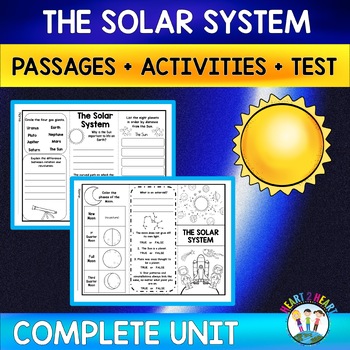
With this creative activity pack, your students will love learning about the Solar System. This complete unit includes information about the Solar System, Sun and Moon, moon phases, stars and constellations, Neil Armstrong, Sally Ride, and the Earth’s rotation vs. revolution.
It has leveled reading passages, comprehension questions, hands-on activities, a flip book, fact flaps, vocabulary posters, character studies on Neil Armstrong and Sally Ride, a unit test, answer keys, and much more!
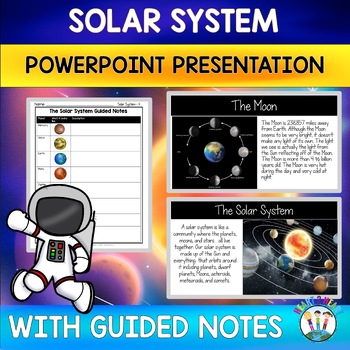
A solar system is like a community where the planets, moons, and stars all live together. Our solar system is made up of the Sun and everything that orbits around it, including planets, dwarf planets, moons, asteroids, meteoroids, and comets. In our solar system, there are eight planets: Earth, Jupiter, Mars, Mercury, Neptune, Saturn, Uranus, and Venus.
There are kid-friendly informational articles about the following:
✔ The Sun
✔ The Moon
✔ Phases of the Moon
✔ The Solar System
✔ Rotation vs. Revolution
✔ The Constellations
✔ Mercury
✔ Venus
✔ Earth
✔ Mars
✔ Jupiter
✔ Saturn
✔ Uranus
✔ Neptune
✔ Pluto
Plus students will learn about two famous astronauts:
✔ Meet Neil Armstrong
✔ Meet Sally Ride
There are lots of hands-on activities:
- Solar System Chart
- Which Planet is it?
- Exit Slips
- Video links shared from YouTube
- Planet Fact Flaps
- Rotation vs. Revolution Activity
- Phases of the Moon Chart
- Brochure Activity
- Writing Prompts (2)
- Venn Diagrams
- 8 Planet Informational Posters
- Teacher’s Pacing Guide
- Vocabulary Posters
- Vocabulary Flip Flaps
- 9-Page Solar System Flip-Up Booklet
- Spotlight on Vocabulary
- Unit Test
- Answer Keys
There are 3 main activities:
Vocabulary:
Introduce the vocabulary words with the real-life photo posters included. You could post these posters around the classroom and have students travel around to match up and define the words in their flip flaps or use as a center activity. These posters are excellent for a bulletin board display too.
Informational Articles:
Have students read the informational articles all about the Solar System with comprehension questions and scenes for students to connect and color. You could have students work with a partner or in small groups or even as a center or learning station activity.
Student Activities:
Have students complete the Solar System Flip-Up booklet and build it page by page. The Flip-Up is built so the planets go in order of their relation to the Sun. Each page of the Flip-Up booklet includes a graphic organizer that has students answer questions about that specific planet such as:
✔ How long does it take to turn on its axis?
✔ How long does it take to orbit the Sun?
✔ Where is it in relation to the Sun?
✔ Describe what it looks like?
✔ Tell one interesting fact
✔ And more!
All the answers for each planet are found in the related articles. I usually have them do one page at each center or learning station. They can use the articles as a reference source to help them complete the pages of the booklet. Lastly, they cut, color, and assemble the booklet. Flip-Up books can be glued or stapled inside their interactive notebooks, file folder, or a 12×18 piece of construction paper folded like a book cover.
There’s also a Which Planet is it? Activity, Solar System Quiz, and Venn Diagrams to compare the planets.
Plus, there are 8 colorful Planet Posters with lots of diagrams, additional info, and facts about each planet to help students visualize the planets and/or to use as part of a learning station, research project, or for an awesome bulletin board display.
Have fun teaching the Solar System with this complete and creative non-fiction resource with 65 pages in all!
CCSS: Earth Science
Meets S4E1: Students will compare the contrast the physical attributes of stars, star patterns, and planets.
b. Compare the similarities and differences of planets to the stars in appearance, position, and number in the night sky.
c. Explain why the pattern of stars in a constellation stays the same, but a planet can be seen in different locations at different times.
Meets S4E2: Students will model the position and motion of the Earth in the solar system and will explain the role of relative position and motion in determine sequences of the phases of the moon.
a. Explain the day/night cycle of the Earth.
b. Explain the sequence of the phases of the Moon.
c. Demonstrate the revolution of the Earth around the Sun and the Earth’s tilt to explain the seasonal changes.
d. Demonstrate the relative size and order from the Sun of the planets in the solar system.
✔ For Elementary Grades – Second grade, Third grade, Fourth grade, Fifth grade
✔ Great for Core Knowledge
✔ Common Core Aligned