Subject: Science

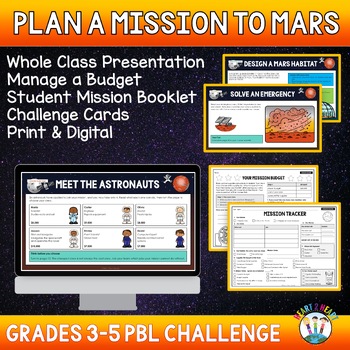
  • Plan a Mission to Mars Space Exploration PBL Grades 3-5

    Plan a Mission to Mars Space Exploration PBL Grades 3-5

    Plan a Mission to Mars is a space exploration project based learning mission for 3rd, 4th and 5th grade. Mission Control has approved a new journey to Mars, but the crew, supplies, habitat, and exploration plan have not been chosen. That’s where your students come in.

    Working in mission teams, students read about Mars and the real robots that have explored it, choose one of three missions, hire four astronauts, manage a $60,000 budget, design a safe habitat, plan a rover exploration, solve a Mars Mission Challenge Card, graph their mission data, and report back. Every choice they make early on shapes the rest of the mission.

    This is a full PBL simulation, not a packet of worksheets. It works as a space unit, a STEM project, or two weeks of cross-curricular lessons.

    What’s Included:

    • Student mission booklet, 27 pages
    • Whole-class slideshow, 25 slides
    • Teacher notes, pacing guide, standards alignment and answer keys
    • Google Slides version of the slideshow and the student booklet
    • Three nonfiction passages with questions
    • Five video connections from NASA and National Geographic
    • Choose Your Mission and Meet the Astronauts
    • Mission Budget and The Supply Store
    • Design a Mars Habitat and Habitat Math
    • Plan Your Mars Exploration
    • 8 Mars Mission Challenge Cards with a solution guide
    • Mission Data and Graph
    • Mission Report, Mission Patch and Reflection
    • Mission Letter
    • Student Grading Rubric
    • Optional extension activities

    ❤️ Why Teachers Love It:

    ✅ Low prep. Print the booklet, print and cut the challenge cards, open the slideshow, and teach.

    ✅ Cross-curricular by design. Science, math, reading and writing all serve the same mission.

    ✅ Math with a purpose. Budgets, area, perimeter, rover distances and a scaled bar graph.

    ✅ Every answer key is done for you, plus ideas to listen for on every challenge card.

    ✅ Print + digital. Works on paper, in Google Classroom, or both.

    Standards:

    NGSS: 3-5-ETS1-1 and 3-5-ETS1-2, engineering design connections through the habitat and the challenge (supporting connections, not a complete NGSS assessment).
    Math CCSS: 3.NBT.A.2 and 4.NBT.B.4, 3.OA.D.8 and 4.OA.A.3, 3.MD.B.3, 3.MD.C.7 and 4.MD.A.3, 3.MD.D.8.
    ELA CCSS: RI.3.1, RI.4.1, RI.5.1; RI.3.7, RI.4.7, RI.5.7; W.3.2, W.4.2, W.5.2; W.3.8, W.4.8, W.5.8; SL.3.1, SL.4.1, SL.5.1; optional W.3.1, W.4.1, W.5.1.

    Please note: the Mars Exploration Team, the astronaut candidates and the mission itself are fictional, created for this simulation. No person has ever been to Mars. The Mars facts and the real missions and robots in the passages and videos are real and sourced.
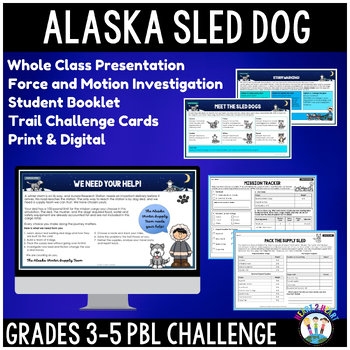
  • Alaska Sled Dog Supply Challenge Force and Motion PBL Grades 3-5

    Alaska Sled Dog Supply Challenge Force and Motion PBL Grades 3-5

    Alaska Sled Dog Supply Challenge is a force and motion project based learning mission for 3rd, 4th and 5th grade. A storm is closing in, a remote research station is waiting for emergency supplies, and your students are the team chosen to complete the delivery.

    Students join the Alaska Winter Supply Team: they read about Denali’s real working sled dogs, build a team of four dogs, pack the sled under a 100-pound mission cargo limit, investigate how load and friction change the pull, choose a route, do the mileage math, and solve the challenges waiting along the trail. Every choice they make earlier decides how the mission ends.

    This is a full PBL simulation, not a packet of worksheets. It works as a science unit, a winter unit, an early finisher project, or a week of cross-curricular lessons.

    What’s Included:

    • Student mission booklet, print and go
    • Whole-class slideshow for projecting the mission
    • Teacher pages, setup notes and answer keys
    • Google Slides version
    • Nonfiction passages with questions, including The 1925 Serum Run
    • Mission Vocabulary
    • Force and Motion Activity
    • Meet the Sled Dogs and Build Your Sled Dog Team
    • Pack the Supply Sled, with a 100-pound cargo limit
    • Does Load Change the Pull? investigation
    • Choose Your Alaska Route
    • Trail Challenge Cards
    • Mission Report
    • Mission Letter
    • Student Grading Rubric
    • Optional extension pages

    ❤️ Why Teachers Love It:

    ✅ No prep. Print the booklet, open the slideshow, and teach. Nothing to cut, laminate or assemble.

    ✅ Cross-curricular by design. Science, math, reading and writing all belong to the same trip.

    ✅ Real force and motion. Students investigate friction and load with a fair test or a no-prep data option.

    ✅ Every answer key is done for you, including the math.

    ✅ Print + digital. Works on paper, in Google Classroom, or both.

    Standards:

    NGSS: 3-PS2-1, partial/supporting alignment with the hands-on investigation only (Option A). Supporting connections with either investigation option: 3-PS2-2 and 3-5-ETS1-1, 3-5-ETS1-2, and 3-5-ETS1-3. Conceptual connections: 3-LS4-2 and 4-LS1-1.
    Math CCSS: 3.NBT.A.2 and 4.NBT.B.4, 3.OA.D.8 and 4.OA.A.3, 3.MD.B.3, 4.MD.A.2.
    ELA CCSS: RI.3.1, RI.4.1, RI.5.1; W.3.1, W.4.1, W.5.1; W.3.2, W.4.2, W.5.2; SL.3.1, SL.4.1, SL.5.1.

    Please note: the sled dogs, the research station and the supply mission are fictional characters and settings created for this simulation. The Denali sled dog facts and the 1925 Serum Run are real and sourced.

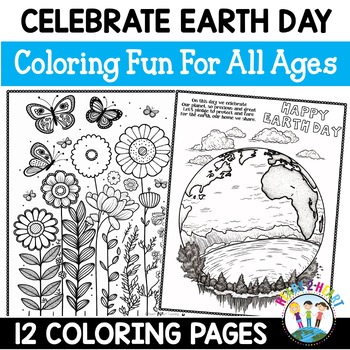
  • Earth Day Doodle Coloring Pages

    Earth Day Doodle Coloring Pages

    Students will love these Earth Day Doodle Coloring Pages. This pack comes with 12 coloring pages and 4 pages have poems that can be used for National Poetry Month. Coloring activities provide students with time to relax and express themselves creatively.

  • Rocks and Minerals Complete Unit

    Rocks and Minerals Complete Unit

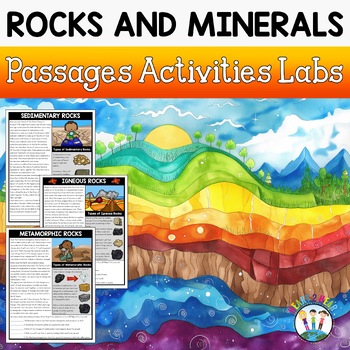
    Rocks and Minerals Rock! This unit has 10 leveled reading passages, organizers, tri-fold brochure activity, unit test (editable), flipbook, vocabulary posters, science labs, comprehension and connection activities, and much more!

    This unit includes many interactive activities and learning opportunities for students with leveled reading passages that focus on:

    • Rocks and minerals
    • Igneous Rock
    • Sedimentary Rock
    • Metamorphic Rock
    • Amazing Minerals
    • Colorful Crystals
    • Layers of the Earth
    • Tectonic Plates
    • Volcanoes
    • The Rock Cycle

    What’s inside:

    • Leveled Reading Passages
    • Teacher’s Pacing Guide
    • Teacher’s Directions & Notes
    • Three Types of Rocks Pocket Sort
    • Three short videos on safeshare.tv
    • Facts About Rocks and Mineral Notebook Flaps
    • Label The Rock Cycle
    • Rocks Rock Tri-fold Booklet
    • Name That Rock or Mineral Activity
    • Label and Color the Layers of the Earth
    • Layers of the Earth Flip Flaps
    • How are Mountains Formed (Tectonic Plates)
    • Science LABS (8)
    • Flip Booklet (5 pages)
    • Mineral Field Guide (4-pages)
    • Unit Test (Editable)
    • Answer Keys

    Plus the vocabulary posters with real-life photos make an attractive bulletin board.

    ✔ Vocabulary Posters

    ✔ Spotlight on Vocabulary Activity

    ✔ Vocabulary Flip Flaps

    ✔ For Elementary Grades – 2nd grade, 3rd grade, 4th grade

    ✔ Great for Core Knowledge

    ✔ Common Core Aligned

    This unit highlights the following key points:

    • How are rocks changed?

    • Explain the difference between erosion and weathering.

    • What are the three types of rocks?

    • What is sediment?

    • How are rocks and minerals related?

    • How is an igneous rock formed?

    • Name and describe three types of igneous rock.

    • How is a sedimentary rock formed?

    • Name and describe three types of sedimentary rock.

    • How is a metamorphic rock formed?

    • Name and describe three types of metamorphic rock.

    • Explain the rock cycle.

    • What is a mineral?

    • How are minerals helpful?

    • How are crystals formed?

    • What are the layers of the Earth?

    • How are mountains formed?

    • Name and describe three types of mountains.

    • What is a volcano?

    • How can a volcano affect our environment?

    There are four main parts of the unit:

    Reading:

    A teacher’s copy of the passages is in color. Read the leveled reading passages about rocks and minerals and complete the organizers. Each passage has comprehension questions to check for understanding. Watch the videos and complete the various hands-on activities in this pack to reinforce learning. These activities work well in small groups, partners, or in stations.

    Students can build the flipbook page by page. I usually have them do one page at each center or station. They can use the articles as a reference source to help them complete the pages of the flip-up. Lastly, they cut, color, and assemble the booklet. Flip-up books can be glued or stapled inside their interactive notebooks.

    Science Labs:

    This unit has 8 labs where students work as geologists to identify two mystery minerals. NOTE: Extra supplies are needed to complete the labs. Please read through the teacher’s directions to prep for the labs.

    Vocabulary:

    Introduce the vocabulary words with the real-life photo posters included. You could post these posters around the classroom and have students travel around to match up and define the words in their flip flaps or spotlight on the vocabulary page. These posters make an excellent bulletin board display in a snap!

    There are lots of activities for differentiation depending on the needs of your students and the time allotted for this unit.

    Be sure to check out the PREVIEW for more information!

    Please know that I spend a lot of time researching, creating, writing, and proofreading my work but even after several revisions there may still be a typo or grammatical error. Please let me know if you find a typo or feel that a correction is needed. Just click on the Ask a Question section or email me at heart2heartteaching@gmail.com versus leaving negative feedback so that I can fix it as soon as possible. I value your input to make my products the highest quality possible. Thank you in advance for your help and support!

    Copyright © Heart 2 Heart Teaching LLC. All rights reserved. This file is intended for classroom and personal use only. Any redistribution or reproduction of part or all of the contents in any form is prohibited other than the following:

    **You may print for your personal, classroom use, and non-commercial use only.

    **Clipart, graphics, photographs, found inside this product are copyrighted. They may not be extracted from this file without written permission from the original artist(s).

  • Weather Activities Unit with Clouds, Weather Maps, Weather Instruments, Weather Tools

    Weather Activities Unit with Clouds, Weather Maps, Weather Instruments, Weather Tools

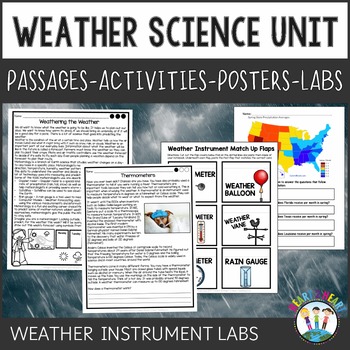
    Learning about the weather has never been so much fun! You will love this creative and interactive pack with information on erosion, forecasting, types of clouds, weather instruments, and meteorology all in one pack!

    Weather is an important part of our everyday lives. Knowing what the weather is going to be like helps us decide whether to wear shorts, carry an umbrella, or wear a warm coat and mittens each day. Meteorologists gather information about the weather using many different tools and instruments. They then make a forecast or prediction about what the weather will be like.

    In this unit students will learn all about:

    ✔ Weather

    ✔ Weathering & Erosion

    ✔ Types of Clouds

    ✔ Meteorologists & Forecasting

    ✔ Weather Maps

    ✔ Weather Vocabulary

    Weather Instruments such as:

    ✔ Barometer

    ✔ Wind Vane

    ✔ Rain Gauge

    ✔ Anemometer

    ✔ Thermometer

    In this complete unit students will work on many hands-on creative activities including:

    ✔ Meet Benjamin & Marie – young scientists

    ✔ Meet Mr. Daniel Gabriel Fahrenheit

    ✔ Meet Mr. Anders Celsius

    ✔ Vocabulary Posters – with real-life photos

    ✔ Vocabulary Flip Flaps

    ✔ Cause/Effect

    ✔ Mystery Weather Flaps

    This weather activity pack includes several Informational Articles with real photos about weather, weathering, erosion, types of clouds, weather instruments, forecasting the weather, meteorologists, weather maps, and so much more!

    ✔ Weather Organizer with Connection Questions

    ✔ 6 Weather Maps with questions

    ✔ Thermometer Activities

    ✔ Clouds Accordion Fold Booklet

    ✔ Weather Quiz & Reflection

    There Are 6 Main Parts of This Weather Unit:

    Introduce the Weather Unit with Meet Benjamin & Meet Marie who are young scientists and future meteorologists. They are in color and black and white depending if you want to use them for the bulletin board or individual use.

    Introduce the 12 vocabulary weather words with the real-life photo posters included. You could post these posters around the classroom and have students travel around to match up and define the words in their flip flaps or use as a center activity. In addition, the vocabulary flip flaps are a great hands-on activity that works well in their interactive notebooks. Looks great on bulletin boards too!

    There are several informational articles with organizers, comprehension, and connection questions. It starts with basic weather concepts with informational articles on weathering, erosion, types of clouds, 5 weather instruments, Fahrenheit & Celsius, and forecasting the weather, weather symbols & weather maps. These are great for centers, partner work, and group work, too!

    Have students read all about the weather instruments and complete an activity or experiment. Check out the websites with directions and photos for how-to’s to make homemade instruments for student experiments.

    Then read about Weather Maps and forecasting the weather and Types of Clouds. Included are 5 different weather map activities for students to complete. I recommend printing the weather maps in color as some of the questions ask what the different colors on the map stand for. What I usually do is print a few copies of the maps in color, place these in sheet protectors or laminate. Then you could have the students use a dry erasers marker to answer the questions, check their answers, and erase. Or copy off black and white versions for the students to write their answers and have the color one displayed on the interactive white-board so they can see it in color.

    Additional Student Activities: Cloud Accordion Fold Booklet, Cause & Effect, compare and contrast, Create a Cloud (with cotton balls) Weather Quiz & Reflection.

    ✔ For Elementary Grades – Third grade, Fourth grade, Fifth grade

    ✔ Great for Core Knowledge

    ✔ Common Core Aligned

    Meets S4E4: Students will collect weather data to predict the weather.

    a. Identify weather instruments – thermometer, barometer, rain gauge, wind vane, and anemometer.

    b. Explain how each instrument works and is used in gathering weather data and making forecasts.

    b. Analyze weather charts and maps to predict and interpret weather conditions.

  • From Seed to Sprout: The Life Cycle of a Plant Activity Pack

    From Seed to Sprout: The Life Cycle of a Plant Activity Pack

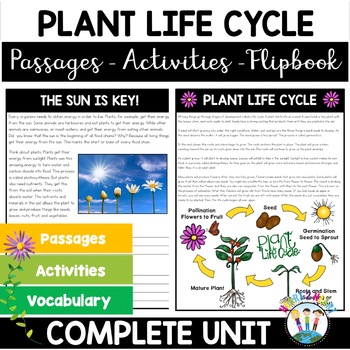
    Students will love learning all about plants and the plant life cycle with this hands-on activity pack! In this unit, there are reading passages, comprehension questions, fun activities, vocabulary posters, and a flip book!

    The life cycle of a plant shows the different stages that occur in a plant’s life. All plants start out as a tiny seed.

    This unit includes reading passages about:
    ⭐ Plants get Energy from the Sun
    ⭐ The Balance of Nature
    ⭐ Plant Life Cycle
    ⭐ Photosynthesis

    There are lots of hands-on activities for students to complement this unit including:
    ✔ Comprehension questions
    ✔ Organizers
    ✔ Life Cycle Diagram
    ✔ Plant Fact Flaps -Great for their science notebooks!
    ✔ Flip Booklet
    ✔ Vocabulary Photo Posters
    ✔ Spotlight on Vocabulary

    There are three main activities in this unit:

    Reading:
    Read the passages about plants, plant life cycle, and photosynthesis and answer the questions on the organizers and label the Plant Life Cycle diagram.

    Hands-on Activities:
    Plant Fact Flaps:
    Students read the statements to determine which of the statements are true. Then they cut and paste the facts underneath the flaps inside their notebooks.

    Plants Flip Book:
    Answer the questions on each page of the flip book. Then cut, color, and assemble the booklet. Flipbooks are an excellent center activity for students to show what they know.

    Vocabulary Activities:
    Print out the vocabulary posters in color or black and white. Post them on a bulletin board or around the classroom. Make copies of the Spotlight on Vocabulary. Have students write the definition or to write a sentence using the word.
    There are two different versions included:
    One has an empty box for students to draw their own illustrations related to the word.
    One has an image for them to color and visualize.

  • Let’s Learn All About Those Creepy Crawly Spiders Activity Pack

    Let’s Learn All About Those Creepy Crawly Spiders Activity Pack

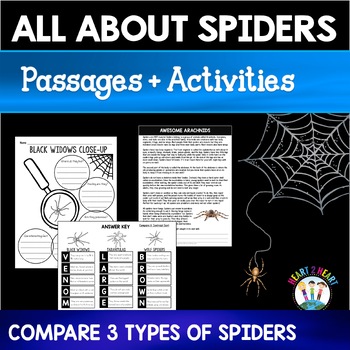
    Learning about spiders can be fun! This unit includes informational articles, hands-on activities, and vocabulary posters for those creepy, crawly creatures. This unit focuses on Arachnids, Life Cycle of a Spider, Black Widow Spiders, Wolf Spiders, and Tarantulas.

    What’s inside:
    ✔ Informational Articles About Awesome Arachnids, Black Widows, Wolf Spiders, Tarantulas and Life Cycle of a Spider
    ✔ Black Widows Close Up
    ✔ Spotlight on Wolf Spiders
    ✔ Tarantulas Uncovered
    ✔ Compare & Contrast All Three Spiders–Cut-n-Sort Activity with Hidden Words
    ✔ Black Widows Fact Wheel
    ✔ Wolf Spider Fact Wheel
    ✔ Tarantulas Fact Wheel
    ✔ Labels the Parts of a Spider
    ✔ All about Spiders Fact or Opinion
    ✔ Life Cycle of a Spider Diagram
    ✔ Spiders Flip Booklet (5-pages)
    ✔ Vocabulary Flip Flaps
    ✔ Spotlight on Vocabulary
    ✔ Spider Vocabulary Posters

    There are lots of hands-on activities and organizers for students to show what they know. This pack can be set up as five fun activities for centers for a weeklong investigation.

    This pack includes six vocabulary posters with real-life photographs for students to connect to the information. There are several vocabulary activities included too. These colorful posters make an awesome bulletin board in a snap!

    There are three main activities in this pack:
    Vocabulary:
    Introduce the six vocabulary words with the real-life photo posters included. You could post these posters around the classroom and have students travel around to define the words in their flip-flaps that fit nicely inside their science notebooks. There is a Spotlight on Vocabulary. These colorful posters make an awesome bulletin board display too!

    Reading:
    Next, have students read the informational articles all about spiders, the life cycle of a spider and more. Read the case studies where they will learn about Black Widows, Wolf Spiders, and Tarantulas. There are organizers for each type of spider to reinforce learning.

    Activities:
    ✔ Comparing All Three Spiders (Cut-n-Sort Activity with Hidden Words)
    ✔ Black Widows Fact Wheel
    ✔ Wolf Spider Fact Wheel
    ✔ Tarantulas Fact Wheel
    ✔ Labels the Parts of a Spider
    ✔ All about Spiders Fact or Opinion
    ✔ Life Cycle of a Spider Diagram
    ✔ PLUS a 5-page Spiders Flip Booklet

  • Let’s Explore Our Solar System PowerPoint

    Let’s Explore Our Solar System PowerPoint

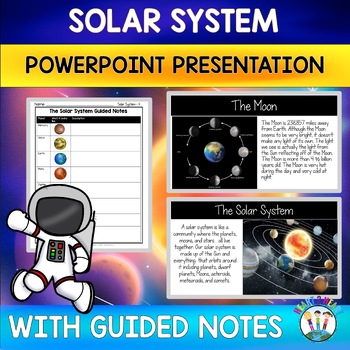
    Your students will love learning about the Solar System with this creative Solar System PowerPoint Presentation! A solar system is like a community where the planets, moons, and stars all live together.

    There are 100 Slides in this PowerPoint Presentation with information about the following:
    ✔ The Sun
    ✔ The Moon
    ✔ Phases of the Moon
    ✔ The Solar System
    ✔ Constellations
    ✔ Mercury
    ✔ Venus
    ✔ Earth
    ✔ Mars
    ✔ Jupiter
    ✔ Saturn
    ✔ Uranus
    ✔ Neptune
    ✔ Pluto

    Plus students will learn about two famous astronauts:
    ✔ Meet Neil Armstrong
    ✔ Meet Sally Ride
    ✔ For Elementary Grades – Second grade, Third grade, Fourth grade
    ✔ Core Knowledge and Common Core Aligned

    This slideshow is geared for 2nd grade, 3rd grade, and 4th-grade students. It has an 8 question activity called “Which Planet is it?” Answers are includes—Perfect to check for understanding or to use as a pop quiz. Plus there are 12 vocabulary words and slides too!

  • Let’s Explore Our Solar System Activity Pack

    Let’s Explore Our Solar System Activity Pack

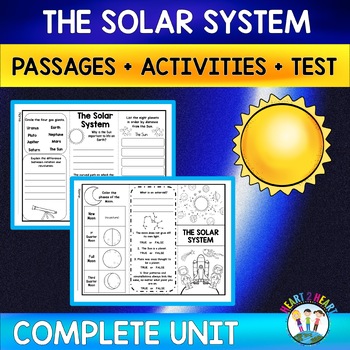
    With this creative activity pack, your students will love learning about the Solar System. This complete unit includes information about the Solar System, Sun and Moon, moon phases, stars and constellations, Neil Armstrong, Sally Ride, and the Earth’s rotation vs. revolution.

    It has leveled reading passages, comprehension questions, hands-on activities, a flip book, fact flaps, vocabulary posters, character studies on Neil Armstrong and Sally Ride, a unit test, answer keys, and much more!

    A solar system is like a community where the planets, moons, and stars all live together. Our solar system is made up of the Sun and everything that orbits around it, including planets, dwarf planets, moons, asteroids, meteoroids, and comets. In our solar system, there are eight planets: Earth, Jupiter, Mars, Mercury, Neptune, Saturn, Uranus, and Venus.

    There are kid-friendly informational articles about the following:
    ✔ The Sun
    ✔ The Moon
    ✔ Phases of the Moon
    ✔ The Solar System
    ✔ Rotation vs. Revolution
    ✔ The Constellations
    ✔ Mercury
    ✔ Venus
    ✔ Earth
    ✔ Mars
    ✔ Jupiter
    ✔ Saturn
    ✔ Uranus
    ✔ Neptune
    ✔ Pluto

    Plus students will learn about two famous astronauts:
    ✔ Meet Neil Armstrong
    ✔ Meet Sally Ride

    There are lots of hands-on activities:

    • Solar System Chart
    • Which Planet is it?
    • Exit Slips
    • Video links shared from YouTube
    • Planet Fact Flaps
    • Rotation vs. Revolution Activity
    • Phases of the Moon Chart
    • Brochure Activity
    • Writing Prompts (2)
    • Venn Diagrams
    • 8 Planet Informational Posters
    • Teacher’s Pacing Guide
    • Vocabulary Posters
    • Vocabulary Flip Flaps
    • 9-Page Solar System Flip-Up Booklet
    • Spotlight on Vocabulary
    • Unit Test
    • Answer Keys

    There are 3 main activities:

    Vocabulary:
    Introduce the vocabulary words with the real-life photo posters included. You could post these posters around the classroom and have students travel around to match up and define the words in their flip flaps or use as a center activity. These posters are excellent for a bulletin board display too.

    Informational Articles:
    Have students read the informational articles all about the Solar System with comprehension questions and scenes for students to connect and color. You could have students work with a partner or in small groups or even as a center or learning station activity.

    Student Activities:
    Have students complete the Solar System Flip-Up booklet and build it page by page. The Flip-Up is built so the planets go in order of their relation to the Sun. Each page of the Flip-Up booklet includes a graphic organizer that has students answer questions about that specific planet such as:
    ✔ How long does it take to turn on its axis?
    ✔ How long does it take to orbit the Sun?
    ✔ Where is it in relation to the Sun?
    ✔ Describe what it looks like?
    ✔ Tell one interesting fact
    ✔ And more!

    All the answers for each planet are found in the related articles. I usually have them do one page at each center or learning station. They can use the articles as a reference source to help them complete the pages of the booklet. Lastly, they cut, color, and assemble the booklet. Flip-Up books can be glued or stapled inside their interactive notebooks, file folder, or a 12×18 piece of construction paper folded like a book cover.

    There’s also a Which Planet is it? Activity, Solar System Quiz, and Venn Diagrams to compare the planets.

    Plus, there are 8 colorful Planet Posters with lots of diagrams, additional info, and facts about each planet to help students visualize the planets and/or to use as part of a learning station, research project, or for an awesome bulletin board display.

    Have fun teaching the Solar System with this complete and creative non-fiction resource with 65 pages in all!

    CCSS: Earth Science
    Meets S4E1: Students will compare the contrast the physical attributes of stars, star patterns, and planets.
    b. Compare the similarities and differences of planets to the stars in appearance, position, and number in the night sky.
    c. Explain why the pattern of stars in a constellation stays the same, but a planet can be seen in different locations at different times.

    Meets S4E2: Students will model the position and motion of the Earth in the solar system and will explain the role of relative position and motion in determine sequences of the phases of the moon.
    a. Explain the day/night cycle of the Earth.
    b. Explain the sequence of the phases of the Moon.
    c. Demonstrate the revolution of the Earth around the Sun and the Earth’s tilt to explain the seasonal changes.
    d. Demonstrate the relative size and order from the Sun of the planets in the solar system.
    ✔ For Elementary Grades – Second grade, Third grade, Fourth grade, Fifth grade
    ✔ Great for Core Knowledge
    ✔ Common Core Aligned

  • Let’s Go on a Scavenger Hunt to Learn About Our Solar System

    Let’s Go on a Scavenger Hunt to Learn About Our Solar System

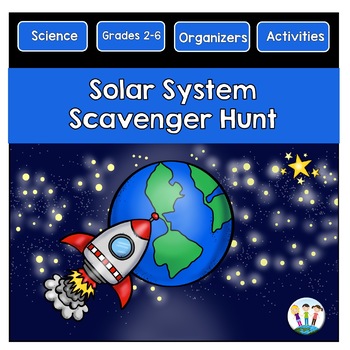
    This Solar System Scavenger Hunt rocks the planet! It’s a fun and creative activity to learn about all the planets!

    What’s inside:
    ✔ 8 Full-Color Planet Posters with information and pictures about each planet
    ✔ Solar System Scavenger Hunt (2 pages)
    ✔ Scavenger Hunt Answer Keys

    Colorful Planet Posters:
    After learning about the Solar System use this pack with 8 colorful Planet Posters with the real-life photos and information all about the planets.

    Ideas for Use:
    You could post these posters around the classroom and have students travel around to find the answers on the Solar System Scavenger Hunt.

    Another option is to use them as an activity for learning stations. Simply print the Planet Posters in color and place them inside a sheet protector or laminate them. Have students answer the questions on their Solar System Scavenger Hunt pages. These work well as a partner or small group activity. The answer keys are included so that you can check their work or have them check their answers.

    ✔ For Elementary Grades – Third grade, Fourth grade, Fifth grade
    ✔ Great for Science Centers

  • Save Our Earth! Earth Day Activity Pack

    Save Our Earth! Earth Day Activity Pack

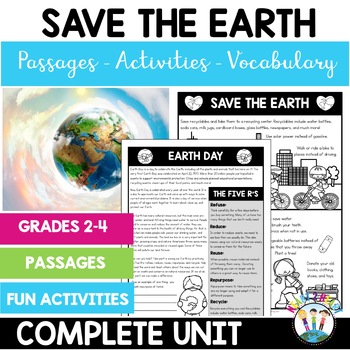
    Celebrate Earth Day with this Earth Day Activity Pack! This pack has been newly updated to include the Five R’s, new vocabulary posters, and lots of hands-on activities.

    Your students will love celebrating Earth Day with this creative and interactive non-fiction resource. This activity pack includes kid-friendly reading passages about:
    ✔ What is Earth Day?
    ✔ Ways to Save Our Earth
    ✔ How You Can Help
    ✔ The Five R’s

    The first Earth Day was celebrated on April 22, 1970. Earth Day was created to make people aware of the importance of keeping planet Earth healthy and clean. There are many ways that students can help protect our Earth too. Learn all about it with this Earth Day Activity Pack!

    This Earth Day Activity Pack also includes Engaging Hands-on Student Activities:
    ✔ Scavenger Hunt
    ✔ Earth Day Poster
    ✔ Earth Day Flip Book (5 pages)
    ✔ Mini-booklet (12 pages)
    ✔ Pretzel Activity Page
    ✔ Writing Prompts
    ✔ Vocabulary Posters
    ✔ Spotlight on Vocabulary

  • Let’s Learn All About the Amazon Rainforest PowerPoint

    Let’s Learn All About the Amazon Rainforest PowerPoint

    This artfully designed presentation has 62 slides that are very engaging for students to learn about the Amazon Rainforest! This is a great compliment to any Rainforest Unit.

    This Rainforest PowerPoint product highlights many science topics such as:
    1. Ecosystems
    2. Photosynthesis
    3. Deforestation
    4. Camouflage
    5. Animal Adaptations
    6. Layers of the Rainforest
    7. The Importance of the Amazon Rainforest
    8. Poison Dart Frogs
    9. Three Toed Sloths
    10. Jaguars

    With this product, students learn about the Amazon Rainforest as well as other topics related to science, animals, and the environment.

    This presentation includes everything you need to teach, investigate, and learn all about the Amazon Rainforest with slides of information on:
    ✔ Four Layers of the rainforest
    ✔ Animals of the Rainforest
    ✔ Poison Dart Frog
    ✔ Three Toed Sloths
    ✔ Jaguars
    ✔ Rainforest Deforestation
    ✔ Ecosystem
    ✔ Photosynthesis
    ✔ 6 Question Rainforest Quiz with answers
    ✔ For Elementary Grades – Second grade, Third grade, and Fourth grade
    ✔ Core Knowledge and Common Core Aligned